By: Dr Fleur van Rens, Dr Andrea Steele, & Lisa Luce
In the first half of 2023, we collected data on perfectionism and mental health in circus artists. Although the full results of this research are not available yet (scientific research takes time…), we would like to give you a sneak peek into what we have noticed in our results so far!
What is perfectionism?
From research in other performing arts domains (such as dance) we know that levels of perfectionism are high among performing artists. Very broadly, perfectionism is often explained as a personality characteristic that involves a pursuit of flawlessness accompanied by self-criticism. In that sense, some people believe perfectionism to be the key to achieving excellence, while simultaneously believing it may negatively impact mental health. When we look in more detail, perfectionism is a little bit more complex than this. Perfectionism is a multidimensional construct, which means that there are multiple components to perfectionism that are related, but also different to each-other. Various researchers have defined the components underlying perfectionism in different ways. In this research, we were looking at three different types of perfectionism:
1) Self-critical perfectionism is the tendency to harshly criticise oneself when one believes their performance is not perfect. People who have high levels of self-critical perfectionism are concerned about making mistakes, are worried about their actions, and have an overly negative response to perceived setbacks or failures.
2) Rigid perfectionism describes the belief that one’s performance should be perfect and flawless. People who have high levels of rigid perfectionism believe it is important to be perfect, and base their self-worth on how perfect they believe themselves to be.
3) Narcissistic perfectionism describes the tendency to demand perfection from others. People who score high on narcissistic perfectionism tend to experience a sense of entitlement and grandiosity because the person believes themselves to be pretty much perfect.
What did we look at in our study?
In our study, we looked at the extent to which these types of perfectionism related to different aspects of the mental health of circus artists. The circus artists completed validated scales that measure perfectionism, and scales that measure aspects of positive and negative mental health. We also asked some questions about the circus artists’ age, gender, and circus experience. Our survey was completed by 622 circus artists from a range of disciplines (aerial acrobatics, floor acrobatics, object manipulation and equilibrium), who described themselves as engaging in circus at various levels (amateur, student, part-time professional, full-time professional). On average, the circus artists were 29 years of age.
What did we find?
We are still working on the full analysis and hope to publish the findings in a scientific journal by the end of 2024. Our preliminary research findings from correlational analyses show that self-critical perfectionism was related to all aspects of mental health that we measured. We found that high levels of self-critical perfectionism were associated with greater emotional states of depression, anxiety and stress, which are indicators of negative mental health. High levels of self-critical perfectionism were also associated with lower levels of flourishing and body appreciation, which are indicators of positive mental health. Rigid perfectionism was similarly associated with these aspects of mental health, but the relationship between rigid perfectionism and mental health was not as strong as the relationship between self-critical perfectionism and mental health. Narcissistic perfectionism was not found to be related to most aspects of mental health, except that high scores on narcissistic perfectionism were weakly associated with decreased emotional states of stress. Our next step in the analysis is to check what happens to these relationships when we take other factors into account.
What do our preliminary findings mean?
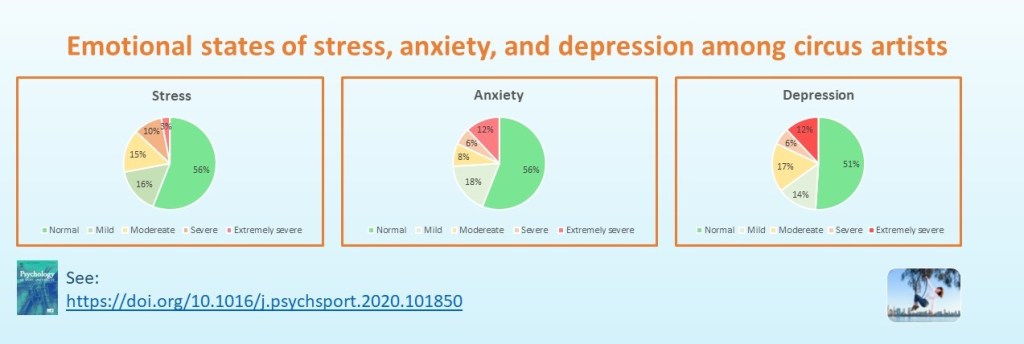
So far, it looks like self-critical and rigid perfectionism might explain the low levels of mental health in circus artists that we have found in previous studies (see Van Rens & Heritage, 2021). Knowing which aspect of perfectionism impacts the mental health of circus artists most will help us guide practice under the big top, as well as provide important information to psychologists to facilitate the mental health of circus artists. So far, our findings seem to show that we need to ensure that we help circus artists decrease their levels of self-critical perfectionism. How do we do this, you may wonder. That’s an excellent question, and it’s not an easy job to do. Research from applied psychologists (not in circus, but elsewhere) has shown that it is possible though. Following recommendations from these studies, and working together with psychologists who specialize in perfectionism may be a great step forward in improving the mental health of circus artists.


 Along with colleagues, I have also investigated team coordination and peak performance in juggling dyads. We wanted to understand how two jugglers manage to keep the balls (or any other prop) in the air by doing “the right thing, at the right time, and for the right reason”. We learned that, in order to perform optimally, two jugglers get their breathing rates and heart rates in sync, probably by learning how to co-regulate their activation levels and attentional states. Moreover, when we looked at the jugglers inter-brain interactions during cooperative juggling, we learned that, for the most part, the two jugglers activated similar areas of the brain. That is, to perform optimally in team settings, jugglers need to leave their Individual Zone of Optimal Functioning and find their Shared Zones of Optimal Functioning, wherein they can sync their minds and bodies.


 Circus Psychology